Thursday, 16 May 2013

Revisiting Strawberry Hill


Horace Walpole, author of The Castle of Otranto and several other works, discovered Chopp’d Straw Hall in 1747 while it was one of the last remaining sites available on the banks of the Thames in fashionable Twickenham. Possibly inspired by Gibb’s Gothic Temple after a visit to Stowe, Walpole set about transforming what was then a couple of cottages into his “little gothic castle” (Walpole) with a veneer of pointed arches, fretworks and battlements set in vast grounds. The inner walls were papered with imitation stonework and it was on the central, dimly lit staircase he experienced his waking vision of a giant armored fist. This inspired what is continuously described as the first Gothic novel which was successively printed within Strawberry Hill on the first private printing press in the country.
In creating Strawberry Hill, Walpole inspired a new fashion for Gothic in both architecture and literature. While houses like nearby Marble Hill were based on classical traditions of order and symmetry, Walpole chose the architecture of Gothic cathedrals as the inspiration for his villa.
The chimney pieces, doors and ceilings are based on Gothic vaulting, medieval tombs and rose windows.
Winding corridors and gloomy passageways open into the sudden splendor of rooms like the gallery and the library where furnishings included a mixture of, “period pieces and quaint oddities.”
Walpole wrote The Castle of Otranto in less than two months, he is often described at this time as a man possessed, “the castle possessed him like a spirit.
Walpole is quoted as saying that, “there is no wisdom comparable to that of exchanging what is called the realities of life for dreams. "Old castles, old pictures, old histories make one live back into centuries that cannot disappoint one.” Walpole’s sensitive personality had accessed at an early point of the eighteenth century the stirrings of romantic influence. Literature in reaction to the Age of Enlightenment gave way from formality and reason to the wondrous unknown, to beauty intertwined with mystery.


Friday, 10 May 2013

The Corpus and the Corpse. Thomas Lovell Beddoes and the Limitations of Anatomy.


Little known Physio-poet Thomas Beddoes was born into a literary family, his mother was the sister of the novelist Maria Edgeworth and his father (a physician, scientist, and radical educator) a friend of Samuel Taylor Coleridge.


 Beddoes was educated at Oxford and, like his literary hero Percy Bysshe Shelley, published his first book, a Gothic romp entitled The Improvisatore, while still an undergraduate. His next work, The Bride's Tragedy (1822), follows in the tradition of the revenge drama, and was heavily influenced by Shakespeare and other Renaissance writers; it had the further distinction of being the only financial success Beddoes ever had. He spent most of his adult life in various cities in Continental Europe (once being banished from Göttingen because of drunkenness, later being banished from Bavaria and Sweden for radical political activity), studying medicine and anatomy as well as writing. Most of his literary energy was devoted to Death's Jest-Book, begun in 1828.

“I search with avidity for every shadow of proof or probability of an after-existence” Sadly Beddoes never achieved his goal and his growing sense of disillusionment eventually led to his second,
and this time, successful attempt at suicide in 1849. “I am food for what I am good for – worms”, he wrote in his last letter and will to friend Revell Phillips. Beddoes is often described by his critics as having a ‘death drive’ or ‘skeleton complex’ which has been linked not only to early bereavements but to his father the elder Dr.Beddoes habit of performing dissections in front of his children, for educational purposes.
            Throughout his medical studies and writing Beddoes displays an obsession with an explanation for death, the nature of the soul and the existence of an after-life; his scientific search concealing an “emotional one of almost manic intensity.” Beddoes has been known as a ‘poet of fragments’ as he destroyed much of his own work demonstrating a perfectionist nature which ultimately to a creative dry-spell, meaning that arguably his best known work Death’s Jest-Book was not published until 1850 posthumously, with a memoir by his friend T. F. Kelsall. Death’s Jest-Book was a  piece of work that had frustrated Beddoes, he himself naming it ‘still-born’, ‘never-ending and a ‘horrible waste of time’. His collected poems followed in 1851. Critics have found it difficult to neatly summarise Beddoes, as illustrated in this quote by Susan Wolfson and Peter Manning.


 The last Elizabethan, a Jacobean scion, an eighteenth-century graveyard poet resurrected in the Romantic age, an original interpreter of the English-German vogue of ‘Gothic’ terror, the dark rearguard of second-generation Romanticism, a soul-mate of Baudelaire and Poe, the first modernist and, with his comic grotesqueries, a precursor of the twentieth-century theater of the absurd.”


             This perhaps explains why this pastiche of a poet has captured my interest and that of many critics displayed in a bibliography (which is by no means comprehensive at this stage) below.
I intend to look at Beddoe’s exploration of the body and the soul in his selected works and place it in the context of the “nineteenth century medical culture’s treatment of the soul (uneasy with the notion of its existence yet unable to deny the possibility) The question being whether he achieves his goal of “healing the disjunction” between the soul and the physical body.


Thursday, 11 April 2013

Local Literary Landscapes - Coleridge's Cottage


The Rhyme of the Ancient Mariner is one of the earliest poems that I genuinely felt inspired by.
Coleridge's cottage situated in Nether Stowey, Somerset is a great day out for literary lovers and landscape enthusiasts alike.

The 17th-century cottage was home to Coleridge for three years and it was during this time that Coleridge wrote his finest works, including: The Rhyme of the Ancient Mariner, Kubla Khan, Frost at Midnight, The Nightingale, Cristabel and This Lime Tree Bower my Prison.
Both Coleridge and Wordsworth are seen as crucial in the development of the literary romantic movement.

The cottage that Coleridge knew would have looked very different to the present building as extensive alterations took place in the late 1800s when 'Moore's Coleridge Cottage Inn' attracted Victorians visiting the area.
As a result of a major redevelopment project in 2011, you can now explore parts of the cottage never previously open to the public and explore atmospheric cottage rooms which have been recreated as though the Coleridge family had just walked out for a stroll themselves.


This inspirational area housed not only the Coleridge family but, for a time, William Wordsworth and his wife at Alfoxton Park, which is now a country hotel.
Wordsworth and Coleridge worked together and later produced the Lyrical Ballads, which are often thought to mark the beginning of  British Romantic literature.


National trust - Further Information
Poetry and Biography of Coleridge

Thursday, 4 April 2013

A Collection of Folk Tales - Two - The Welsh Bards.


The tragic tale of Edward I's massacre of the Welsh bards has long inspired artists and poets.

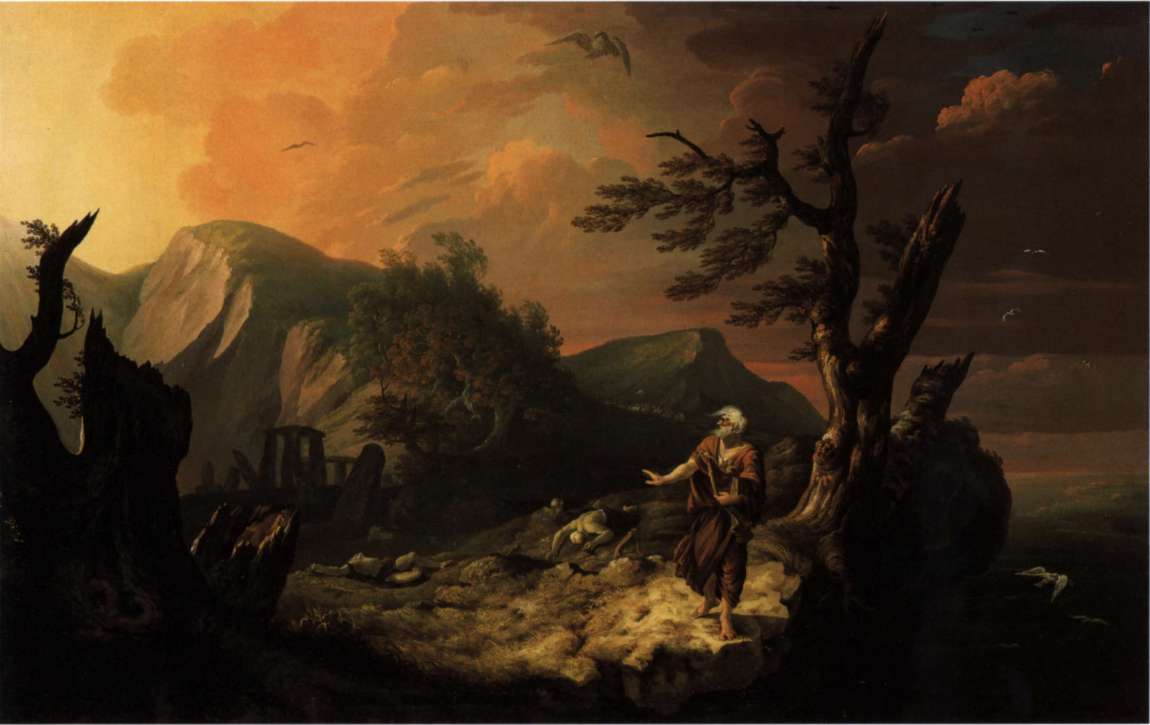
Thomas Gray popularised the legend in his romantic poem The Bard (1768) and in 1774, Thomas Jones painted a scene of the dramatic moment when rather than submit to King Edward's invading English army, the last Welsh bard takes his own life.

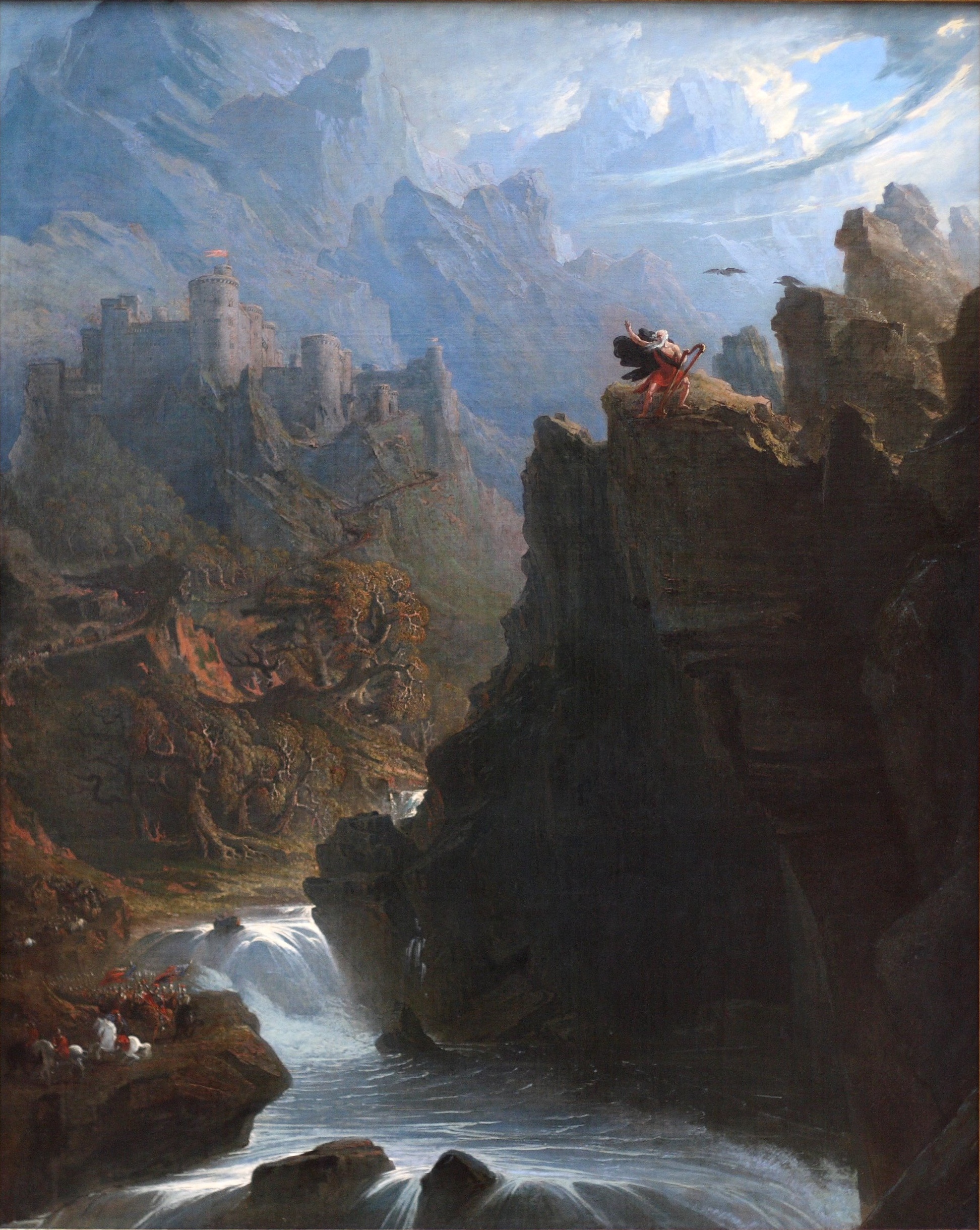
This painting by John Martin also 
comes from Thomas Gray's poem 
and depicts Edward I's Conwy Castle looming overhead.

The sole surviving bard here stands:

'On a rock, whose haughty brow


Frowns o'er old Conways foaming 
flood,


Robed in the sable garb of woe,
With haggard eyes the Poet stood;

(Loose his beard and hoary hair

Stream'd, like a meteor, to the troubled air) 

(II. 15-20)
He curses the departing armies:
'Ruin seize thee, ruthless King!
Confusion on thy banners wait' 

(II. 1-2)

Between the seventeenth and eighteenth- century there was considerable research being carried out in to British History and the legitimate line of the monarchy and through this interest grew a fascination with Celtic literature and the role of the bard.
The bard was often pictured standing on a precipice, a lonely poet amongst ruins and decay.
Emerging from this were several literary forgeries, ancient manuscripts claimed to have been found by the likes of Chatterton and Macpherson's Ossian became a phenomenon.
A fascination with the Celtic languages and history became widespread.


Here as some useful links for more information.
BBC History Video - 'The Bardic Tradition'

The Bard by Thomas Gray with artwork by William Blake

Rossetti and Renunciation


As an individual I find Christina Rossetti particularly fascinating and Goblin Market has always been high up on my list of favorite poems. There has been a significant amount of critical discussion on Christina and her brother Dante Gabriel and below I explore briefly just one tiny part of that analysis -  Rossetti and the theme of renunciation in her poetry.           

Rossetti, was the product of an unusual upbringing of Italian and English Victorian middle class. Raymond Chapman elaborates on this interesting point, “the sensuous hunger of her southern temperament warred with a growing sense that her lot was to be renunciation. If her religion was a release of tensions it partly created, there is no derogation of that faith or of the writing which it influenced.”  The theme of renunciation runs not only throughout her poetry, which is often mystical in tone, but throughout her life. In one of Anthony. H Harrison’s most recent works he states that, “historically, criticism of Rossetti has properly emphasised her renuciatory mind-set. Vanitus Mundi is her most frequent theme.”
 
Rossetti also demonstrates the consequences of failing to resist temptation  as explored in perhaps Rossetti’s most famous work Goblin Market. In this poem, Laura succumbs to temptation and takes the goblin fruit from the goblin males which results in a rapid decline in her life on earth. She is then regenerated only by the self-sacrifice of her sister who resists temptation and takes the abuse of the goblins. Mary Arseneau adds, “Laura is committing the error warned against; she is focusing exclusively on the senses and is ceasing to look beyond the physical to the more important spiritual and moral issues.”   
        
 Similarly in Maude, the spiritual breakdown of the protagonist who feels unworthy of going to communion due to the worldly temptations resulting from her art eventually results in her death.      
         Harrison elaborates;

“this literary construct usually involves initial desires for fulfillment of passion in this world, which are or have been) undermined by an experience of betrayal (either by the beloved or illusory ideals). Renunciation or at least withdrawal from the active pursuit of love follows disillusionment; often the speaker craves death, either as an anodyne or as a transposition to an afterlife of absolute love, in which the beloved regenerated as an eschatological figure or is replaced by God,” (139) which demonstrates both Laura and Maude’s desire for death.
        
Additionally, in Betty Flower’s introduction to the 2001 collection of Rossetti’s poetry she speaks of the poem The World;
“Rossetti reveals meaning through her lyric diction, utilizing such phrase choices as "subtle serpents" and "ripe fruits." The English love sonnets that inspired her work often used romantic images of "fruits" and "sweet flowers," which use in "The World" creates a seemingly paradoxical image when preceded by the phrase "subtle serpents." This paradox therefore reveals her contradiction between innocent romantic love and sinful erotic desire. When viewed in terms of the Fall, the two phrases remain completely analogous, thus implying that romantic love and erotic desire are one in the same sin. Rossetti had, in fact, "a great horror of Ă”ther world' in the sense which the terms bears in the New Testament; its power to blur all the great traits of character, to deaden all lofty aims, to clog all the impulses of the soul aspiring to unseen Truth"
        
Jerome .J. Mcgann, a particularly influential critic on Rossetti states that,
“her poetry is an oblique glimpse into the heaven and the hell of late Victorian England as that world was meditated by the experiences of Rossetti. Rossetti’s heaven and hell are always conceptualised in terms of personal love relations: true and real love as opposed to the various illusions of happiness, pleasure and fulfilment.”(139)

         
This point by Mcgann also demonstrates one aspect the platonic influences upon Rossetti’s poetry. Rossetti utilises the cave allegory often as she speaks of the illusions we experience here on earth, shadows of the real thing which we can unveil when eros is renounced, or as Harrison adds “she exemplifies the pathway, the ladder of love, its joyful ascent toward a more perfect beauty than we have ever actually yet seen.” (133)  Diane D’Amico makes a similar point, simply put that “renunciation in this life leads to reward in the next” (64) and it is this fundamental belief which focuses Rossetti on a life of renunciation. She adds,

“when considering the renunciatory state of Christina Rossetti’s poetry,, it is also essential to recall that for Rossetti , renunciation of worldly pleasure was only a part of the spiritual journey; the goal was always to heaven. Therefore, in reading Rossetti’s poems that urge the reader to renounce the world or to beware the temptations of the world, one must keep in mind her belief in a reward of individual mortality and spiritual joy.”(64)

If this has led you to wanting to learn more about Rossetti,(and I sincerely hope it has - she is wonderful), then here is an interesting newspaper article and a link to the Goblin Market poem to get you started.

Guardian poem of the Week - Goblin Market.
Christina Rossetti - Goblin Market Full Poem


Jessica's Twitter

Monday, 1 April 2013

Poet's Corner - One

I walk through the winding streets
the twists I know so well.
To the fire with my kin
to meet the judge of all.

Dressed in holy robes

to hide the demonic brand
that surely adorns the body of he
who executes on steadfast land.

The city walls are my final comfort

only abandoning us at the close,
for who could keep out such a serpent
or save us from the fire he chose?

Sunday, 31 March 2013

Burke's Sublime

The mind becomes more creative when we are imagining rather than perceiving infinite elements.

Best known for his political work Reflections of a Revolution in France, Burke became a reference point for many of the Gothic writers with his definition of the sublime.
A framework entitled Philosophical Enquiry in to the Origin of our Idea of the Sublime and Beautiful.  Within this framework are seven points, all concerning obscurity which are essential to an object gaining the description of ‘sublime’.


Here are some key quotes from the text:


Astonishment - “The passion caused by the great sublime in nature, when those causes operate most powerfully, is astonishment; and astonishment is that state of the soul, in which all its motions are suspended with some degree of horror.”


Delicacy- “An air of robustness and strength is very prejudiced to beauty. An appearance of delicacy and even of fragility is almost essential.”

Terror - “No passion so effectually robs the mind of all its powers of acting and reasoning as fear. Whatever, therefore is terrible with regard to sight, is sublime too.”

Power – “Besides those things which directly suggest the idea of danger, I know nothing sublime which is not some modification of power. The emotion you feel is, lest this enormous strength should be employed to the purposes of rapine and destruction.”


Privation – “Vacuity, darkness, solitude and silence.”

Vastness – “Greatness of dimension is a powerful cause of the sublime. A perpendicular has more force in forming the sublime, than an inclined plane; and the effects of a rugged and broken surface seem stronger than where it is smooth and polished.”


Infinity – “Another source of the sublime is infinity. Infinity has a tendency to fill the mind with that sort of delightful terror, which is the most genuine effect and truest test of the sublime.”

Obscurity – “To make anything very terrible, obscurity seems in general to be necessary. When we know the full extent of any danger, when we can accustom our eyes to it, a great deal of the apprehension vanishes.”


Obscurity itself branches off in to seven further points, for Burke names seven types of obscurity.


Meteorological: such as mist, fog, storms and tempests.

Topographical: which concerns impenetrable forests, ivy covered ruins, ice, deserts and boundless oceans.

Architectural: such as labyrinths, castles, abbeys, secret passages and doors, turrets and statues.

Material: is where we find people in disguise or hidden.

Textual: when we are puzzled by riddles, prophecies, broken text and intertextuality.

Spiritual: Catholic settings, rituals and occultism.

Psychological:which deals with the idea of the uncanny, dreams and doubles.

This method becomes formulaic in the Gothic novel ,and is parodied in magazines and Jane Austen’s Northanger Abbey. 


As I am currently carrying out research in to the 'Gothic' expect many more related posts!


Here is a full copy of the piece. Burke's Sublime and Beautiful

Jessica's Twitter Account

Sunday, 9 December 2012

Quick Quote - Alice in Wonderland

Still lurking in my top five favorite books is Lewis Carroll's Wonderland series. here are a few lesser known quotes.


“I wonder if the snow loves the trees and fields, that it kisses them so gently? And then it covers them up snug, you know, with a white quilt; and perhaps it says "Go to sleep, darlings, till the summer comes again.” 


“If you don't know where you are going any road can take you there”


“I can't go back to yesterday because I was a different person then. ”


“If I had a world of my own, everything would be nonsense. Nothing would be what it is, because everything would be what it isn't. And contrary wise, what is, it wouldn't be. And what it wouldn't be, it would. You see?”


“But it's no use now," thought poor Alice, "to pretend to be two people! Why, there's hardly enough of me left to make one respectable person!” 

“She tried to fancy what the flame of a candle is like after the candle is blown out, for she could not remember ever having seen such a thing.”

“Everything's got a moral, if only you can find it”


“Thy loving smile will surely hail

The love-gift of a fairy tale.” 

Friday, 7 December 2012

Relationships in Middlemarch

While many are put off by the sheer size of Eliot's novel Middlemarch, even the BBC drama totaling at roughly seven fifty minute long episodes, the novel is essential as a case study of  rural middle-class Victorians in the midst of vast progression and rapid industrialisation. At this point, social mobility is also growing rapidly with birth no longer determining one's status in society. There is no longer a single coherent religious order and Science and the Darwinian theory are casting religious doubt.

The novel's subtitle 'A Study of Provincial Life' casts a light on what would otherwise be an entangled web of several lives and sub plots with perhaps little coherence. This is a case study on on a selected community of nineteenth century, unknown people and how wider social transformations are represented by these individuals. The novel is written forty years after the setting within the text and so it is looking back, perhaps on occasion with nostalgia at the brink of the change which Eliot would be living in.


One of the most interesting aspects of the novel is the marital relationships between the characters. We have two figure head women in the novel, Dorothea and Rosamund who both marry for the wrong reason and in consequence suffer in unhappy marriages. Dorothea desires real knowledge which society at the time denies her, preferring women to learn menial tasks for amusement with marriage being the main goal. She has progressive ideas and spends her time designing cottages and demonstrating her altruistic nature. She avoids life's pleasures and prefers a spiritual or academic state, examples include her refusal to horse ride despite it being a hobby of hers or denying her mother's jewels even though she finds them beautiful. Her marriage to Casaubon is based on a desire  for self improvement  Casaubon is a late middle-aged scholar who is embarking on a fruitless academic pursuit on finding the key to all Mythology.

Something which is stated in the novel had been achieved by the Germans (in German higher criticism) sometime ago.

 Dorothea desires from her marriage, to be brought to his level of scholarly intellect but finds out that once married Casubon jealously guards his knowledge and desires her to undertake simple tasks rather than letting her learn Greek and Latin which she desires. The selfish character of Casubon is proven to be less than what he appears in that he never actually writes anything and is very poor company for Dorothea. He enters a clause in to this final will upon his death that if Dorothea marries his cousin Ladislaw, with whom Dorothea has formed an acquaintance, then she will be inherited. Indicating his desire to control and limit Dortohea even after his death.


Rosamund, is a very different character to Dorothea although ultimately makes similar mistakes when embarking upon marriage. Rosamund represents 'new money' as opposed to Dorothea's refined , understated 'old money' lifestyle. Rosamund marries Lydgate, who arrives to Middlemarch with great ideas of progression. he wishes to open a pioneering hospital in the town which will treat fever.

 He spends, like Casaubon, much of his time researching but his plans also never come to fruition due to living beyond his means. Rosamund is the beauty of the town and has recently completed finishing school, representing a very different sort of education to what Dorothea desires for herself. She marries the doctor for his connections, lifestyle and the glamour of his novelty in Middlemarch. She uses her 'womanly wiles' and eventually the doctor finds himself married to her after taking pity on her pining tears. Rosamund's lifestyle however, drags Lydgate in to debt as he constantly wishes to please her and keep her living in the comforts she was accustomed to. Eventually she gets her wish and Lydgate gives up his research to become a London practitioner.

These parallels between the two very different relationships show the modern issues which progression can bring upon individuals. When looking at Casubon and Lydgate we also see represented the Victorian idea of 'applied knowledge', knowledge which is for a purpose rather than just for the sake of it.
Casubon's work is utterly pointless and trying to achieve the perfection he desires leads him to waste his life never publishing. Comparatively,  Lydgate's desire to investigating the very building blocks of life instead of focusing on patients also leads him to failure.
 Additionally, Dorothea who has a talent for plans and architecture desires classical knowledge where her skills would be best placed to learn subjects suited to this end. Fred who has a university education but has no strong wish to enter the clergy finds himself getting in to debt and failing at most things he turns his mind to until he becomes an apprentice and learns a practical skills where he finds success and finally earns the hand of the woman he loves.

These interesting topics are but a few exemplified in the novel which has its merit as one of the most detailed texts of Victorian life in the midst of significant change.


Saturday, 1 December 2012

A Collection of Folk Tales - One.


The Lady of the Lake & the Physicians of Myddfai

In the 12th century a young man fell in love with a woman who emerged from the magic lake – Llyn y Fan Fach, in the hills above the village of Myddfai. He was allowed to marry her providing he was faithful, didn't give her three needless blows, nor touch her with iron.
She came with a dowry of goats, cattle, sheep and horses. They were very happy and she bore him three sons.


Unfortunately, he struck his wife once when she laughed during a funeral, once when she cried at a wedding, and  accidently touched her with the metal bit of a bridle as she helped him to harness a horse.


She cried,“You have struck me the last blow. Farewell!” Turning her back on him, she called to the animals to follow her, and disappeared into the lake. The distraught husband drowned in the deep waters of the lake in his frantic search for her.


The lady’s three sons often went to the lake, and one day she re-emerged and told Rhiwallon, the eldest, that he must become a man of medicine and be "a benefactor to mankind by giving relief from pain and misery through healing all manner of diseases".


Rhiwallon and his sons Cadwgan, Gruffydd and Einion all became physicians. Their fame spread. They compiled a treatise published in The Red Book of Hergest, containing prescriptions such as this cure for coughs:-

Coarsely powdered mustard seed boiled with figs in strong ale – also for rheumatism, chilblains, and for preventing drunkenness.
The story of Lady of the Lake is a common old Welsh folk tale and it could possibly relate right back to early race memories of meetings between the two cultures, Celts and the people of the Bronze Age.
In some versions Rhiwallon is described as tall and fair and the lady as small and dark , typical attributes of both races.
Bronze Age people often lived on or beside lakes and were noted for their healing powers and understanding of herbal remedies etc. The warlike Celts arrived with the ability to forge iron. Their iron weapons would have struck fear into the hearts of the indigenous people – thus being ‘touched’ with iron could mean death.


An interesting source on Welsh folklore can be found here (BBC Myths and Legends)

Post information taken from here.